
Latest News
At the World Expo site in Dotonbori, “HIROSHIMA”… a kamishibai featuring a model of an atomic bomb survivor girl was performed in English, and also shared on social media.
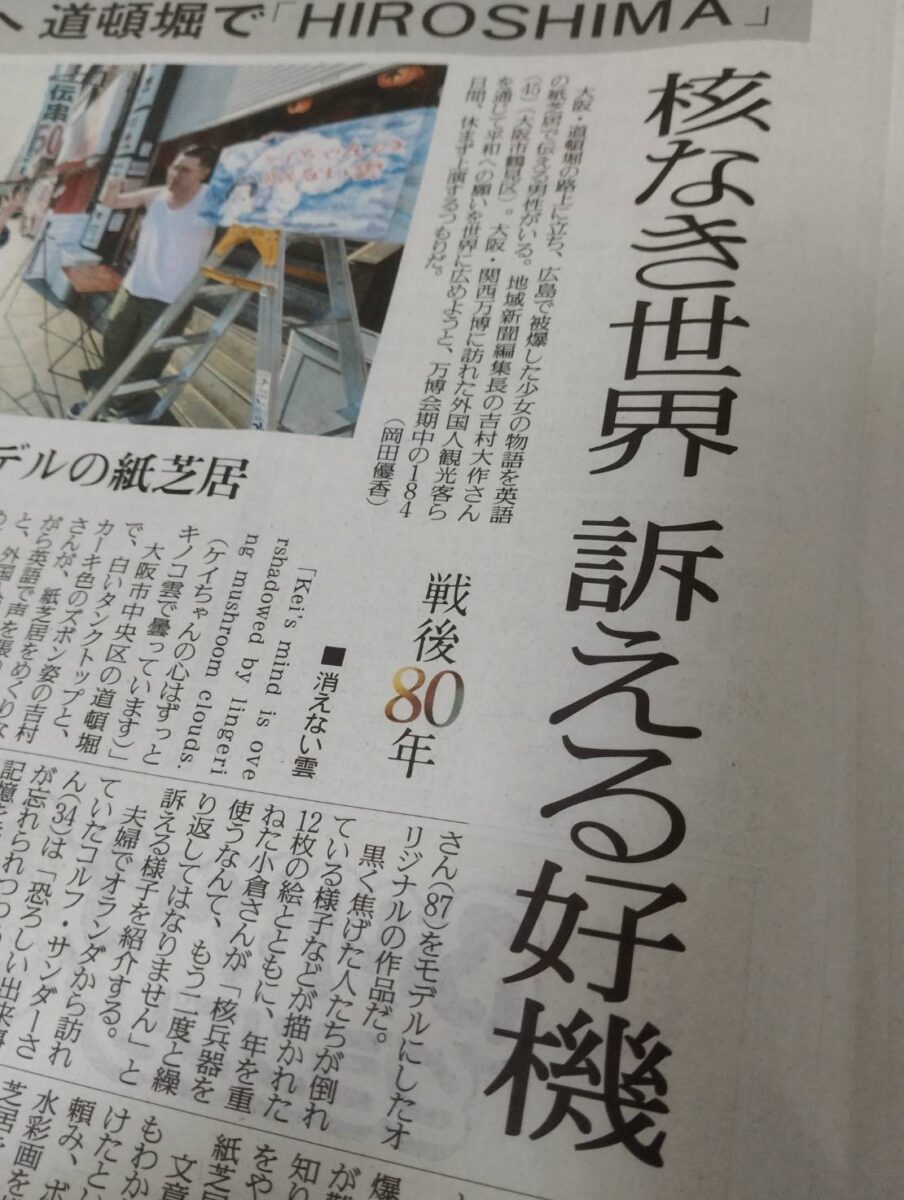
yomiuri shimbun 読売新聞
https://www.yomiuri.co.jp/local/kansai/news/20250508-OYO1T50042/
There’s a man standing on the streets of Dotonbori in Osaka, telling the story of a girl who survived the atomic bombing of Hiroshima through an English-language picture story show. He is Daisaku Yoshimura (45), the editor-in-chief of a local newspaper (Tsurumi Ward, Osaka City). He intends to perform the show every day for 184 days during the Osaka-Kansai Expo, hoping to spread his message of peace to the world through foreign tourists visiting the expo. (Yuka Okada)
The Unfading Cloud
“Kei’s mind is overshadowed by lingering mushroom clouds.”
In Dotonbori, Chuo Ward, Osaka City, Yoshimura, dressed in a white tank top and khaki pants, loudly narrated the picture story show in English, drawing the attention of foreign tourists who stopped to listen.
The picture story show is titled “The Cloud That Won’t Disappear By Kei.” It’s an original work modeled after Keiko Ogura (87), who was 8 years old when she was exposed to the atomic bomb approximately 2.4 kilometers from the hypocenter in Hiroshima.
Along with 12 illustrations depicting scenes such as people lying dead and charred black, the show features an older Ogura appealing, “Nuclear weapons never be used ever again.”
Korf Sander (34), who was visiting from the Netherlands with his wife, said, “I think it’s important to continue passing on these memories, especially as these terrible events are starting to be forgotten.”
Illustrations by an Evacuated Artist
Yoshimura met Ogura in 2022, when Russia began its military invasion of Ukraine. When Ms. Yoshimura visited the Hiroshima Peace Memorial Museum with Yulia Bondarenko (33), an artist who had evacuated from Ukraine, she listened to the atomic bomb survivor’s testimony given by Ms. Ogura, who continues to share her experiences.
Ms. Yoshimura learned that it is becoming difficult for atomic bomb survivors themselves to share their experiences due to their advanced age, and she thought, “I should try to do what I can,” which led her to conceive of the idea of a picture-story show.
When creating the script, she said she made an effort to use expressions that are easy for anyone to understand. Yoshimura asked an acquaintance to translate it and had Ms. Bondarenko create watercolor paintings to complete the picture-story show.
Ms. Bondarenko said, “I understand the pain of the Japanese people. Steadily continuing to do what we can will change the world.”
Ms. Yoshimura struggled with the question of whether it was appropriate for her, a non-survivor, to tell the story, but Ms. Ogura encouraged her, saying, “Just as drops of water gather to form an ocean, each and every person must spread the message of peace.”
Into 100 Languages
The performance is also being shared on social media. With the cooperation of high school students in Osaka, they plan to translate the picture-story show into over 100 languages, including Hebrew, Nepali, and Arabic, and sequentially post them on their website.
The World Expo includes participation from countries and regions facing war and conflict, such as Ukraine and Palestine. Ms. Yoshimura said, “Peace is the premise for considering the future of society. I hope that the World Expo will be an opportunity for people to think about the suffering caused by war and nuclear development.”