Latest News
Descendants of Atomic Bomb Decision-Makers and Victims Connect Across Generations
yomiuri Children shimbun
Descendants of Atomic Bomb Decision-Makers and Victims Connect Across Generations
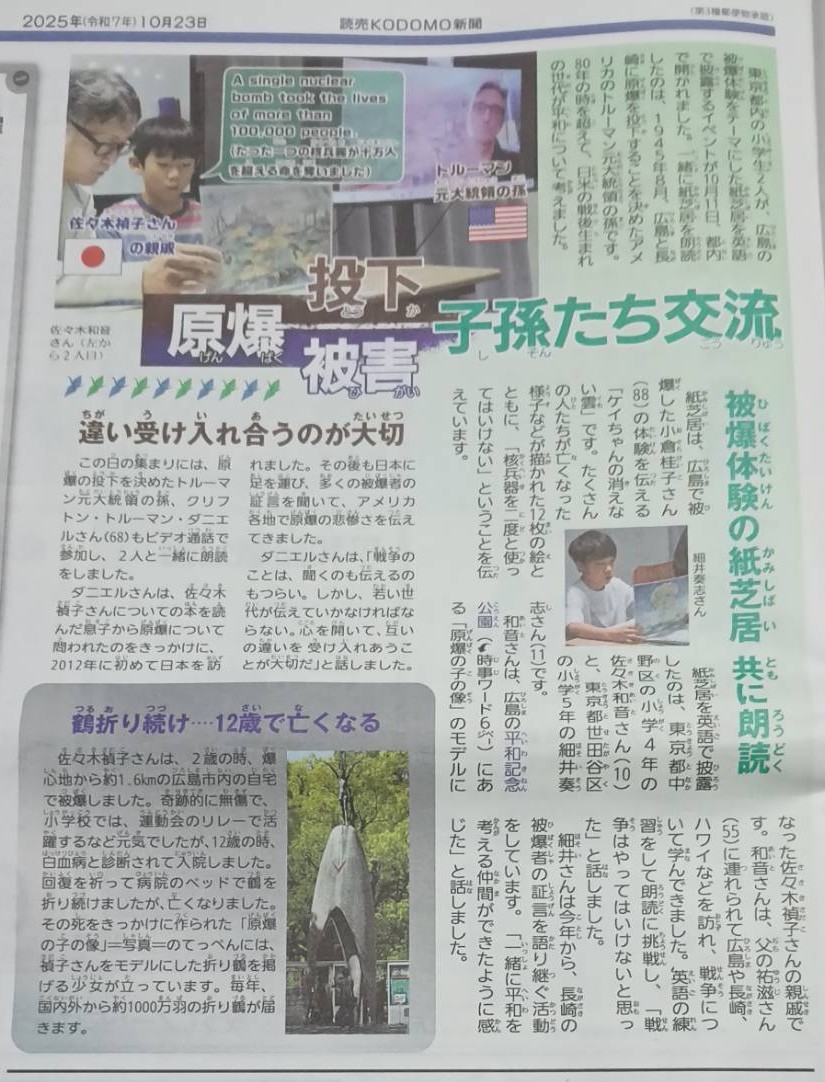
Two elementary school students from Tokyo performed an English picture-story show (kamishibai) about the atomic bombing of Hiroshima at an event held in Tokyo on October 11. Reading alongside them was Clifton Truman Daniel, the grandson of former U.S. President Harry S. Truman, who authorized the atomic bombings of Hiroshima and Nagasaki in August 1945. More than 80 years after the war, descendants from both nations came together to reflect on peace.
Performing a Survivor’s Story Together
The kamishibai, titled “The Cloud That Won’t Disappear—By Kei” tells the experience of Keiko Ogura (88), a survivor of the Hiroshima bombing. Through twelve illustrated panels depicting the devastation and loss of countless lives, the story delivers a clear message: “Nuclear weapons must never be used again.”
The English performance was given by Aito Sasaki (10), a fourth grader from Nakano Ward, and Soushi Hosoi (11), a fifth grader from Setagaya Ward.
Aito is a relative of Sadako Sasaki, the girl who inspired the “Children’s Peace Monument” in Hiroshima Peace Memorial Park. Together with his father, Yuji (55), Aito has visited Hiroshima, Nagasaki, and Hawaii to learn about the war. After practicing hard to read the story in English, he said, “I felt that war must never happen again.”
Soushi, who began sharing testimonies of Nagasaki atomic bomb survivors earlier this year, said, “It felt like I found friends who want to think about peace together.”
Embracing Differences with Open Hearts
Joining the event via video call was Clifton Truman Daniel (68), the grandson of former U.S. President Harry S. Truman, who made the decision to drop the atomic bombs. He read the kamishibai together with the two students.
Daniel first visited Japan in 2012 after his son read a book about Sadako Sasaki and asked him about the atomic bombings. Since then, he has returned multiple times to listen to survivors’ stories and has shared their experiences throughout the United States to convey the horrors of nuclear war.
“Talking about war is painful—both to listen to and to tell,” Daniel said. “But it’s something the younger generations must continue to share. What’s most important is to open our hearts and learn to accept our differences.”